Understanding your internal emotional landscape can feel overwhelming, especially when different parts of you seem to be at war. One part pushes you to achieve perfection while another screams for rest. One part people-pleases while another resents the burden. Internal Family Systems (IFS) therapy offers a framework for understanding these competing voices as distinct ifs parts, each with protective intentions and valuable wisdom. For high-achieving women navigating anxiety, burnout, and perfectionism, recognizing these parts can transform how you relate to yourself and find lasting peace.
What Are IFS Parts in Internal Family Systems Therapy?
IFS parts are distinct subpersonalities or aspects of your psyche, each with its own perspective, emotions, and role in your internal system. Rather than viewing yourself as a single, unified entity, the Internal Family Systems model recognizes that we all contain multiple parts that developed to help us navigate life's challenges.
These parts are not signs of pathology or fragmentation. They are normal, natural aspects of the human mind that emerge in response to our experiences, particularly during childhood and moments of stress or trauma.
The Three Categories of IFS Parts
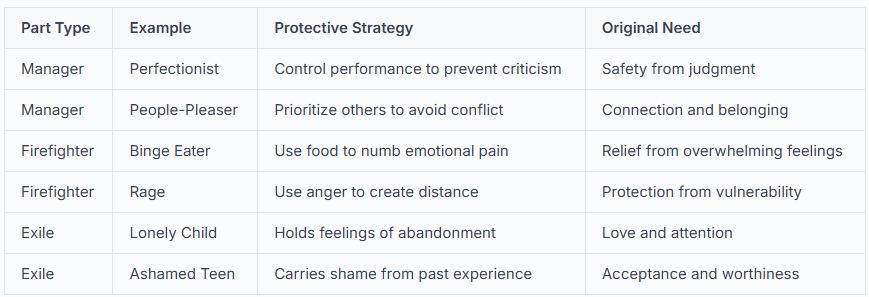
Internal Family Systems organizes ifs parts into three primary categories, each serving a specific protective function:
Managers are proactive protectors that try to keep you safe by controlling your environment and preventing vulnerable feelings from surfacing. Common manager parts include:
The Perfectionist who demands flawless performance
The Planner who obsesses over details and contingencies
The People-Pleaser who prioritizes others' needs to avoid conflict
The Critic who points out every flaw before others can
Firefighters are reactive protectors that spring into action when painful emotions break through despite managers' efforts. These parts use urgent, sometimes destructive strategies to numb or distract from emotional pain:
Binge eating or restriction
Excessive shopping or spending
Substance use
Compulsive social media scrolling
Rage or aggressive outbursts
Exiles are vulnerable parts that carry the burdens of past pain, shame, fear, and trauma. Managers and firefighters work tirelessly to keep these parts locked away because their emotions feel too overwhelming to experience.

Three Types of IFS Parts
How IFS Parts Develop and Function
Your ifs parts didn't appear randomly. They developed as adaptive responses to specific experiences, relationships, and environments throughout your life. A manager part that pushes you toward perfectionism may have formed when you learned that achievement earned love and attention. A firefighter part that uses shopping to cope may have emerged when you discovered that new purchases temporarily soothed loneliness.
The Protective Intent Behind Every Part
Even parts with seemingly destructive behaviors are trying to help you. The ifs parts model recognizes that no part is inherently bad or trying to harm you. Each part believes its strategy, however outdated or problematic, is necessary for your survival and wellbeing.
Consider the inner critic that constantly points out your flaws. While this part feels harsh and mean, it developed to protect you from external criticism or rejection. If you can identify and fix your mistakes first, maybe others won't judge you. The part's method causes pain, but its intention is protective.
Understanding this protective intent transforms your relationship with difficult parts. Instead of battling against them or feeling ashamed of their presence, you can approach them with curiosity and compassion.
The Role of Self in IFS Parts Work
At the core of the Internal Family Systems model is the concept of Self, which is distinct from your parts. Self is your true essence, the calm, compassionate, curious center that can lead your internal system. Unlike parts, which are reactive and role-based, Self possesses inherent qualities that don't need to be learned or developed.
The Eight C's of Self Leadership
When you're in Self, you naturally embody what IFS calls the Eight C's:
Clarity: Seeing situations accurately without distortion
Curiosity: Genuine interest in understanding parts and their stories
Compassion: Warmth and care toward all parts, even difficult ones
Confidence: Trust in your ability to handle challenges
Calm: Peaceful presence even amid internal or external chaos
Courage: Willingness to face difficult emotions and experiences
Creativity: Flexible, innovative problem-solving
Connectedness: Feeling part of something larger than yourself
The goal of IFS therapy is not to eliminate parts but to help Self lead your internal system. When Self is in charge, ifs parts can relax, trust, and release their extreme protective strategies. They can step into healthier, more balanced roles.
Identifying Your IFS Parts
Recognition is the first step in working with ifs parts. Many high-achieving women have spent years disconnected from their internal experience, operating on autopilot while parts run the show behind the scenes. Learning to identify your parts brings awareness to patterns that have shaped your life.
Common Parts in High-Achieving Women
Women navigating anxiety, burnout, perfectionism, and people-pleasing often encounter specific manager and firefighter parts:
The Achiever pushes relentlessly toward goals, equating productivity with worth. This part believes rest equals failure and that slowing down will lead to being left behind or deemed inadequate.
The Caretaker prioritizes everyone else's needs, often at the expense of your own wellbeing. This part learned that your value comes from what you do for others, making setting boundaries feel impossible or selfish.
The Worrier catastrophizes and scans constantly for threats. This anxious part believes that if it can anticipate every possible problem, it can prevent them, keeping you safe from surprise or failure.
The Escape Artist uses various forms of numbing or distraction when emotions become too intense. This firefighter part might manifest as scrolling, binge-watching, overworking, or other avoidance behaviors.

Identifying Your IFS Parts
Noticing Parts in Daily Life
You can begin identifying your ifs parts by paying attention to internal conflicts and shifts in your emotional state. Notice when you feel pulled in opposite directions or when your behavior suddenly changes.
Ask yourself these questions when you notice strong emotions or reactions:
What part of me is showing up right now?
What is this part feeling or believing?
What is this part trying to protect me from?
When did I first meet this part?
These questions help you develop what IFS calls "parts detector," the ability to recognize when a part has taken over your consciousness rather than Self being in the lead.
Working with IFS Parts in Therapy
Internal Family Systems therapy provides a structured approach to healing your relationship with ifs parts. According to recent research published in peer-reviewed journals, IFS interventions show promising results for anxiety, trauma, and depression, making it particularly effective for women dealing with emotional exhaustion and burnout.
The Six F's of IFS
IFS therapy follows a process called the Six F's to help you connect with and heal your parts:
Find the part you want to work with
Focus on it, noticing where you sense it in or around your body
Flesh out the part by learning about its feelings, thoughts, and history
Feel toward the part, noticing your emotional response to it
beFriend the part by developing curiosity and compassion
Fear (address the part's fears about change or healing)
This process helps you move from being blended with (taken over by) a part to having Self-led awareness and compassion for it. When parts feel genuinely seen and understood by Self, they become willing to share their stories and, eventually, release the burdens they carry.
Unburdening IFS Parts
The ultimate goal of working with ifs parts is unburdening, the process through which parts release the painful beliefs, emotions, and roles they've carried. Research on IFS interventions demonstrates that this unburdening process can lead to significant symptom reduction and improved quality of life.
When a manager part that drives perfectionism unburdens, it doesn't disappear. Instead, it transforms into a part that supports healthy achievement without the desperate need to prove worthiness. When an exile unburdens shame, it can integrate back into your internal system as a source of wisdom rather than a source of pain.
For women experiencing emotional burnout, this unburdening process offers profound relief. Parts that have worked overtime to keep you functioning can finally rest, allowing you to access sustainable energy rather than running on fumes.
Practical Applications of IFS Parts Work
Understanding ifs parts transforms how you navigate everyday challenges. Instead of judging yourself for conflicting desires or overwhelming emotions, you can recognize the different parts at play and help them work together.
IFS Parts and Decision-Making
When facing a difficult decision, you might notice multiple ifs parts weighing in with competing opinions. One part wants to take a risk while another insists on playing it safe. One part craves connection while another fears vulnerability.
Rather than forcing a decision or letting the loudest part win, you can facilitate an internal meeting. In Self, you can listen to each part's concerns, understand what they're protecting you from, and make a decision that honors everyone's needs without being controlled by any single part's fear.
Using IFS for Emotional Regulation
According to insights from psychology experts on managing internal conflict, recognizing parts during emotional dysregulation creates space between stimulus and response. When you notice that an anxious part has been triggered or a firefighter part wants to take over, you can pause and access Self.
From Self, you might internally say to the anxious part: "I see you're really worried right now. What are you afraid will happen?" This simple acknowledgment often helps the part calm down enough that it doesn't completely take over your nervous system.
IFS Parts in Relationships
Relationship conflicts often involve ifs parts from both people interacting in unhelpful ways. Your defensive part might trigger your partner's critical part, which activates your wounded exile, which brings out your partner's caretaker part. Understanding this parts-based dynamic helps you pause and respond from Self rather than letting parts run the show.
When you can recognize your partner's behavior as coming from a protective part rather than their entire being, compassion becomes possible even in conflict. Similarly, when you notice your own parts getting activated, you can take responsibility for them rather than blaming your partner for "making you feel" a certain way.
IFS Parts and Trauma Healing
Internal Family Systems was developed by Richard Schwartz in the 1980s and has become increasingly recognized as an effective trauma-informed therapy approach. The parts framework provides a gentle, non-pathologizing way to work with traumatic experiences without requiring detailed retelling of events.
How IFS Approaches Trauma Differently
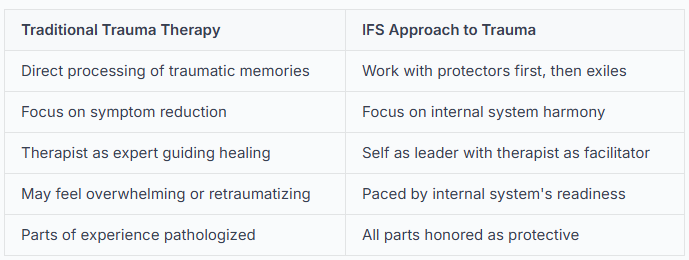
Traditional trauma therapies often focus on processing traumatic memories directly. IFS takes a different approach by first working with the protective parts (managers and firefighters) that have been keeping traumatic memories and feelings at bay. Only when these protectors feel safe and trust Self's leadership do they allow access to the wounded exile parts carrying trauma.
This protective-parts-first approach prevents retraumatization and respects the internal system's wisdom. Your parts have been working hard to keep you functional. They won't allow healing until they're confident that it's safe and that Self can handle what emerges.
The Safety of Working with Exiles
One reason ifs parts work feels particularly safe for trauma survivors is the built-in protection system. Your managers and firefighters won't allow access to exiled parts until they trust that you (in Self) and your therapist can handle the intensity. This creates a natural pacing that prevents flooding or overwhelm.
When the time is right and protectors grant permission, you can approach wounded parts with the compassion and resources you didn't have when the trauma occurred. This reparative experience, witnessing your younger self's pain from the grounded, capable presence of Self, facilitates deep healing. For women exploring options for individual therapy, understanding this gentle approach to trauma can help you feel more confident about beginning the healing process.

IFS Trauma Healing Process
Self-Led Living Through IFS Parts Work
The transformation that happens through working with ifs parts extends far beyond symptom relief. As Self increasingly leads your internal system, you experience a fundamental shift in how you relate to yourself, others, and life's challenges.
Moving from Parts-Led to Self-Led
When parts are running your life, you experience constant internal conflict, extreme reactions, and a sense of being controlled by forces you don't understand. Anxiety, perfectionism, people-pleasing, and burnout are often the result of well-meaning parts working too hard in outdated protective strategies.
As Self takes the lead, these same parts can relax into healthier roles. The achiever part becomes a source of healthy motivation rather than relentless pressure. The caretaker part learns to include you in its circle of care. The worrier part channels its vigilance into appropriate planning rather than catastrophizing.
Sustaining Self Leadership
Self leadership isn't a destination you reach and maintain permanently. Life circumstances, stress, and triggers will activate parts, sometimes intensely. The difference after IFS work is that you have a map of your internal system and tools to return to Self relatively quickly.
When you notice a part has taken over, you can:
Pause and take a few deep breaths
Acknowledge the activated part: "I notice the anxious part is here"
Ask the part to give you some space so you can understand what it needs
Listen to the part's concerns from Self
Reassure the part that you've got this
Make decisions and take actions from Self rather than the activated part
This practice becomes easier with repetition. The ifs parts approach offers a lifetime framework for understanding yourself and navigating whatever challenges arise.
IFS Parts Work in Online Therapy
The accessibility of online therapy has made IFS parts work available to more women than ever before. Virtual sessions allow you to engage in this deep internal work from the comfort and safety of your own space, which many find facilitates the vulnerability required for parts work.
For women in North Carolina, South Carolina, and Pennsylvania who are navigating demanding careers, family responsibilities, and their own emotional exhaustion, Online Therapy offers a flexible format that honors your schedule while providing the depth of healing you deserve. IFS-informed therapy can be conducted effectively online, with the added benefit of being able to integrate insights immediately into your daily environment.
Recent studies, including online group-based IFS interventions for PTSD, demonstrate that virtual formats can be highly effective for parts work. The key is finding a therapist trained in IFS who can guide you through the process of identifying, understanding, and healing your ifs parts.
Intensive Therapy for Deeper Parts Work
For women ready to dive deeply into parts work in a concentrated timeframe, therapy intensives offer an alternative to weekly sessions. In an intensive format, you can work with multiple parts, complete unburdening processes, and experience significant shifts in a matter of days rather than months.
This accelerated approach works particularly well for high-achieving women who want to address burnout, anxiety, or relationship patterns comprehensively. If you're considering whether a weekly or intensive therapy format is right for you, understanding your parts and their needs can inform that decision.
Common Questions About IFS Parts
As you explore the ifs parts model, several questions naturally arise about how this framework applies to your specific situation.
Can You Have Too Many Parts?
There's no "normal" number of ifs parts. Some people identify dozens of distinct parts while others work primarily with a handful. What matters is understanding the parts that are most active in your life and affecting your wellbeing. Over time, you'll likely discover that many seemingly different parts are actually variations of a few core protectors and exiles.
Do Parts Ever Go Away?
Parts don't disappear through IFS work. Instead, they transform and integrate into healthier roles within your internal system. A part that once used extreme strategies to protect you can, after unburdening, become a valuable contributor to your life. The perfectionist might become a healthy motivator. The people-pleaser might become genuinely generous without resentment.
What If Parts Don't Want to Talk?
Some ifs parts are skeptical, shut down, or actively resistant to therapy. This resistance is itself protective and deserves respect. IFS never forces parts to engage before they're ready. Instead, the therapist helps you (in Self) understand why a part might be hesitant and what it would need to feel safe enough to open up. Building trust takes time, and that's okay.
How Is IFS Different from Other Therapy Approaches?
While many therapies acknowledge internal conflict, IFS provides a specific framework and language for working with these conflicts. Unlike cognitive-behavioral approaches that might challenge negative thoughts, IFS seeks to understand the parts generating those thoughts and heal their underlying wounds. Unlike traditional psychodynamic therapy that might interpret defenses, IFS directly engages with protective parts as valuable allies.
The IFS model integrates well with other approaches. Many therapists combine IFS with somatic therapy, EMDR, or attachment-based work to provide comprehensive healing for women navigating complex trauma, anxiety, and relationship challenges.
Understanding your ifs parts offers a compassionate, empowering path toward healing anxiety, burnout, perfectionism, and people-pleasing patterns that have exhausted you for too long. When you recognize that your internal conflicts reflect protective parts trying to help in the only ways they know how, self-judgment can transform into self-compassion. If you're a woman in North Carolina, South Carolina, or Pennsylvania ready to explore your internal system and reclaim Self leadership, Zen with Zur offers IFS-informed online therapy designed specifically for high-achieving women like you. Begin your journey toward internal harmony and lasting peace today.

Mariah J. Zur, LPC, LCMHC
Online Therapist for High-Achieving Women in NC,
SC & PA
