Trauma Therapy Explained
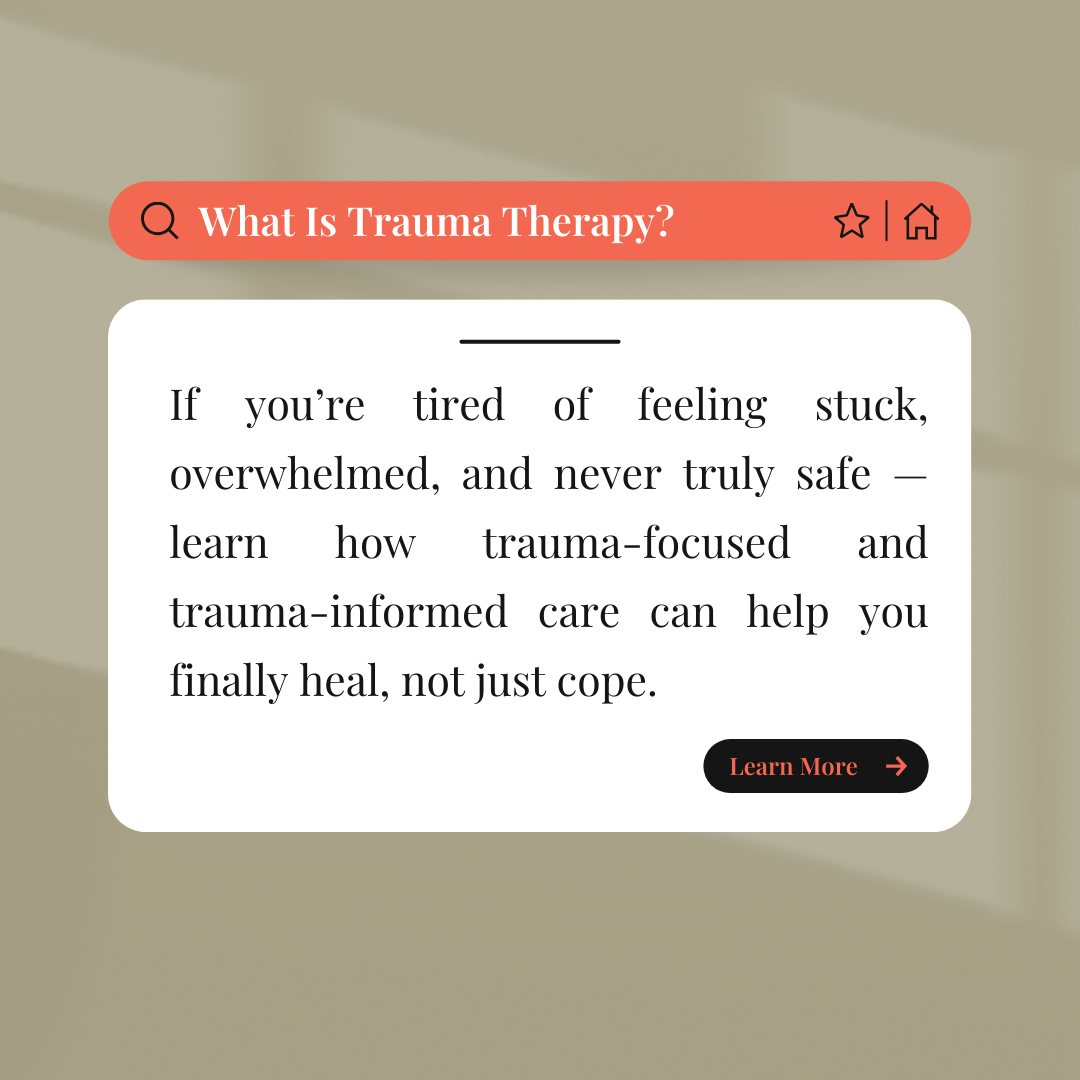
Trauma Therapy Explained: What It Is, Why It’s Hard, and How Trauma-Informed Care Helps You Heal
Let’s be honest, when you start searching for trauma therapy, the jargon can feel almost as overwhelming as the healing itself.
Trauma-focused therapy. Trauma-informed care. Adult trauma therapy.
It’s enough to make your head spin when you’re already carrying a lot. You don’t need another page of psychobabble. You need someone to break it down for you, plain and simple. Keep reading, that’s what I am about to do for you.
What is Trauma-Focused Therapy?
Trauma-focused therapy is exactly what it sounds like: therapy that puts your trauma front and center instead of tiptoeing around it.
The goal isn’t to rehash every painful memory. It’s to help you understand how your trauma shaped you and give you real tools to heal. Therapists might use methods like EMDR, IFS (Internal Family Systems), or somatic work to help you process what happened, instead of just talking about it endlessly.
Instead of asking, “How does that make you feel?” a trauma-focused therapist might help you notice how your body tightens up when you talk about certain memories and guide you through releasing that tension safely.
And here’s why it matters:
Research shows that unresolved childhood trauma can lead to serious long-term impacts. For example, women with childhood trauma histories often experience a more severe course of bipolar disorder, leading to higher hospitalization rates (Şahin et al., 2021). That’s not just a small ripple effect, it's a tidal wave that can change the entire course of someone's adult life.
What is Trauma-Informed Therapy?
While trauma-focused therapy is a specific treatment style, trauma-informed therapy is a mindset every good therapist should have, no matter what you’re working on.
Trauma-informed care principles include:
Safety:You get to move at your own pace.
Trustworthiness:Your therapist keeps it real and transparent.
Peer support:You’re not treated like a “case” you’re seen as a human.
Collaboration:Your voice matters in every step of the process.
Empowerment:You’re not broken. You’re healing.
In trauma-informed therapy, you’re not pushed, judged, or rushed.
You're offered choices and respect because healing isn’t one-size-fits-all.
Example of trauma-informed care: Instead of forcing you to talk about something painful, a therapist might say, “We can pause here. Would you like to stay with this feeling, shift gears, or wrap up for today?”
This approach isn't just about feeling good in the moment.
It's about recognizing that early adverse experiences, like childhood abuse or neglect, can even impair cognitive functions like memory and attention later in life, even in otherwise healthy adults (Majer et al., 2010).
In other words: trauma affects how your brain works long after the danger is over. Yep, you read that right!
What is Trauma Therapy?
Trauma therapy is a bigger umbrella term that covers all kinds of healing work related to trauma. It can help you if you’re dealing with things like:
PTSD
Anxiety and panic attacks
Toxic relationship patterns
Childhood emotional neglect
Chronic overthinking, guilt, or shame
Good trauma therapy doesn’t just teach you how to "cope" better.
It helps you reconnect with yourself and rebuild the parts that trauma tried to tear down.
Here in Pittsburgh and across Pennsylvania, more clients are asking for therapists trained in trauma-informed care because they know that true healing needs more than just “tools” it needs a therapist who actually gets it.
And there’s another reason early support matters:
Studies show that the severity of childhood trauma directly increases the risk of developing serious health conditions later, including obesity and hypertension (Lee et al., 2014). It’s not "just in your head", your body carries the weight of trauma too.
Why is Trauma Therapy So Hard?
Here’s the honest answer most people don’t say out loud:
Trauma therapy is hard because it’s asking you to feel things you’ve spent your whole life trying not to feel.
It’s hard because your brain learned survival habits, like shutting down, people-pleasing, or dissociating, for a reason. When you start healing, you’re peeling those layers back. And sometimes, that hurts.
Hard doesn’t mean wrong, though.
With trauma-informed care examples like going slow, building trust, and celebrating tiny wins, the process becomes more human and less overwhelming. You don't have to bulldoze your way through it (even though your trauma is going to want you to have a plan to fix it fast, that’s normal). You’re allowed to heal at your own damn pace.
What is Trauma Therapy for Adults?
Trauma therapy for adults deals with the messy, complicated ways old wounds show up in your grown-up life.
Maybe you find yourself:
Attracting toxic partners over and over again
Freaking out over “small” things but feeling numb during “big” ones
Sabotaging success because part of you feels like you don't deserve it
Trauma therapy for adults focuses on helping you break free from patterns that aren’t your fault, but are your responsibility to heal now.
Using trauma-informed care 5 principles, safety, trust, peer support, collaboration, and empowerment, therapy can help you stop surviving and start living. Organizations like SAMHSA emphasize the importance of trauma-informed care principles across all healthcare settings, not just mental health.
You don’t have to be stuck in survival mode forever. There’s another way forward.
Signs You Might Benefit from Trauma Therapy
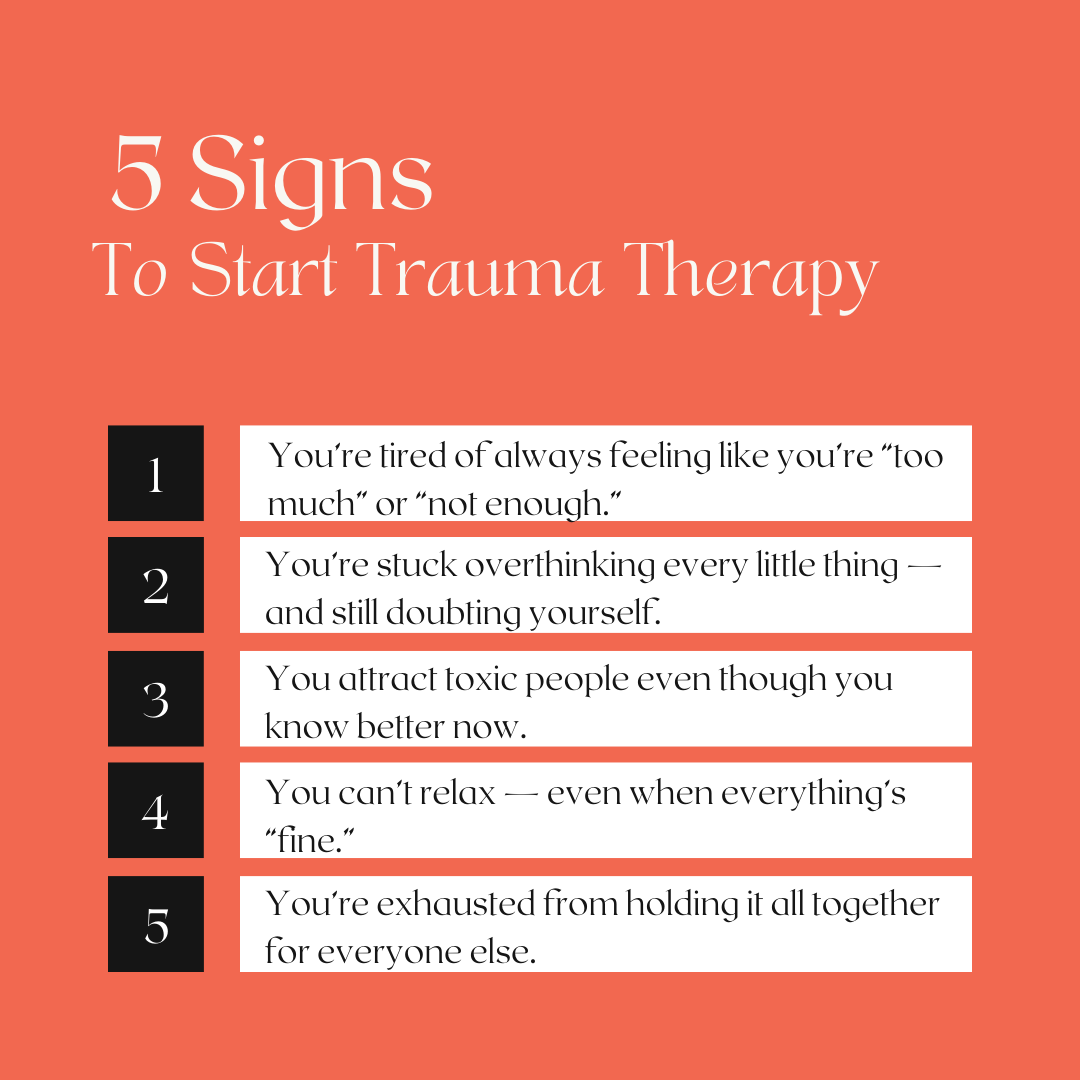
You don't have to hit "rock bottom" to start healing.
If any of these sound familiar, trauma therapy could help:
You feel stuck repeating the same toxic patterns
You have a hard time trusting people (even if you want to)
You either feel too much or nothing at all
You struggle with anxiety, panic, or chronic stress
You feel exhausted by trying to "hold it all together" all the time
You intellectually know you’re safe, but your body still feels on edge
If you're nodding along, you're not broken. You’re in the right space and should probably book a FREE 15-minute call with me so we can get started. You’re just carrying old survival patterns that therapy can help untangle, safely, gently, and at your pace.
You’re Stronger Than You Think
If no one else has told you this yet: You’re not crazy for struggling. You’re courageous for even thinking about healing.
Whether you need trauma-informed care in Pittsburgh or you’re tuning in from across Pennsylvania, know this:
Healing is brutal & messy sometimes, but it’s also breathtaking.You don’t have to figure it out alone.
If you’re ready to work with someone who meets you with trauma-informed care, deep respect, and real talk, Book a free consultation today.
You deserve to feel safe in your own skin again.
FAQ Section: Trauma Therapy and Trauma-Informed Care
What are the five principles of trauma-informed care?
The five core principles are safety, trustworthiness, peer support, collaboration, and empowerment. These trauma-informed care principles guide how therapists create a healing environment that respects your pace and protects your dignity.
How does trauma therapy help adults heal from childhood trauma
Trauma therapy helps adults recognize and unlearn survival patterns they developed as children. It rebuilds trust in themselves and others, helping them feel safer, calmer, and more connected — not just survive, but actually thrive.
What’s the difference between trauma-focused therapy and trauma-informed therapy?
Trauma-focused therapy is a direct treatment targeting trauma itself (like EMDR or IFS). Trauma-informed therapy, meanwhile, is an overall approach that respects trauma’s impact but doesn’t necessarily focus only on trauma in every session.
Why is trauma therapy so emotionally difficult?
Healing often means facing feelings you learned to avoid just to survive. Trauma therapy gently reintroduces those emotions with new tools, creating space for you to experience them safely, without judgment or overwhelm.
Can trauma therapy improve physical health too?
Yes. Studies show trauma therapy can lower risks associated with childhood trauma, such as metabolic syndrome, hypertension, and chronic stress-related illnesses. Healing your mind often leads to healing your body too.
Ready to get started?
If you’re struggling to move forward from a toxic relationship, let’s work together. I offer virtual trauma therapy and intensives across Pittsburgh, Philadelphia, and all of Pennsylvania.

I offer focused therapy intensives for adults who are still functioning but feel worn down by constant pressure, anxiety, or patterns that no longer work. This work is designed for people who want depth, clarity, and relief without labels or long-term weekly therapy. If you’re in North Carolina, South Carolina, or Pennsylvania and curious whether an intensive format could be supportive, you’re welcome to learn more.
Join me on Instagram, Pinterest and TikTok for more educational tips, trauma recovery insights, and updates on therapy intensives in Pennsylvania, North Carolina, and South Carolina.
Disclaimer
The content shared here is for educational and informational purposes only. It is not a substitute for psychotherapy, medical care, or individualized mental health treatment. Reading this blog or engaging with my content does not establish a therapeutic relationship.
If you are experiencing significant distress or feel you need personalized support, I encourage you to seek care from a licensed mental health professional in your state. Therapy is deeply personal, and the right support should be tailored to your specific needs, pace, and circumstances.
For adults located in North Carolina, South Carolina, or Pennsylvania who are seeking focused, confidential support, I offer customized therapy intensives designed to address chronic stress, internal pressure, and patterns that no longer work. Information about these services can be found throughout this site.
About the Author
Mariah Zur, LPC is a licensed therapist who works with high-achieving adults navigating chronic stress, internal pressure, and the quiet unraveling that can happen beneath outward success. Her work is especially suited for individuals who are highly functional, deeply self-aware, and exhausted from holding everything together.
Mariah offers therapy intensives for adults seeking focused, contained support without labels, long-term weekly therapy, or unnecessary exposure. Her approach is grounded, relational, and nervous-system informed, helping clients slow the internal spiral, regain a sense of control, and move forward with clarity and steadiness.
She provides intensive therapy services online across North Carolina, South Carolina, and Pennsylvania, with in-person options available in Raleigh, NC.
Credentials
Mariah J. Zur, MS, LPC
Licensed Professional Counselor
Doctoral Student, Counselor Education and Supervision
