Somatic Tools to Heal Generational Trauma and Inherited Stress
When Thinking Isn’t Enough
You’ve read all the books. You’ve journaled, analyzed, and tried to logic your way out of the exhaustion. But you still feel stuck.
That’s because trauma doesn’t just live in your thoughts—it lives in your body.
For many high-achieving women I work with, this shows up as functional freeze: the body is moving, but the spirit feels shut down. It’s not laziness. It’s survival. And the key to shifting it isn’t thinking harder—it’s somatic (body-based) healing.
Why Trauma Lives in the Body
The science is clear: chronic and generational trauma reshapes the nervous system. Harvard’s Center on the Developing Child describes toxic stress as long-term activation of the body’s stress response without supportive relationships. Over time, this changes brain wiring, stress hormones, and even immune function.
That’s why you can’t simply “think positive” to heal trauma. The nervous system has to learn safety in the body first.
The Freeze Response Explained
When fight and flight don’t feel possible, the body goes into freeze. It’s a nervous system survival mode where energy shuts down to protect you.
Signs of freeze:
Numbness or flatness.
Brain fog or zoning out.
Feeling “dead inside” while still functioning.
Struggling to start even small tasks.
This state is common for women carrying inherited patterns of silence, overwork, or emotional neglect.
5 Somatic Practices to Heal Inherited Trauma
Here are five body-based practices you can use daily to begin thawing freeze and releasing inherited trauma.
1. Orienting: Remind Your Body You’re Safe
Look around the room slowly. Name 5 colors, 5 objects, or 5 textures.
Why it works: Trauma keeps the body braced for danger. Orienting tells your nervous system, “It’s now, not then.”
2. Wall Push: Activate Strength Gently
Stand and push your palms into a wall for 30–60 seconds.
Why it works: Activates dormant muscles and gives the body a sense of agency, which trauma often takes away.
3. Humming or “Vooo”: Reset Through Sound
Hum a low tone or make a long “vooo” sound on the exhale.
Why it works: Vibrations stimulate the vagus nerve, shifting the body out of freeze and into connection.
4. Cold-to-Warm Contrast
Splash cool water on your face, then wrap yourself in warmth (blanket, sweater).
Why it works: Activates the dive reflex, calming the stress response, followed by safety signals through warmth.
5. Grounding Walk
Take a slow walk. With each step, notice your heel-to-toe contact with the ground.
Why it works: Physical rhythm regulates the nervous system and reconnects body and mind.
How to Make These Practices Stick
Consistency matters more than intensity. Think of these like reps at the gym for your nervous system.
Start small: 1–2 minutes is enough.
Pair with routines: Try orienting before a meeting or humming before bed.
Track your body: Notice shifts in breath, tension, or energy after practice.
Over time, your nervous system learns new options besides freeze.
Personal Perspective
When I was stuck in functional freeze in my 30s, I thought therapy wasn’t “working” because I couldn’t think my way out. Once I added somatic tools—wall pushes between sessions, humming in the car, orienting in stressful moments—I felt alive again.
It wasn’t instant. But these tiny practices rewired my system enough to make space for deeper therapy (IFS, boundary work). Somatic healing gave me a body to come home to.
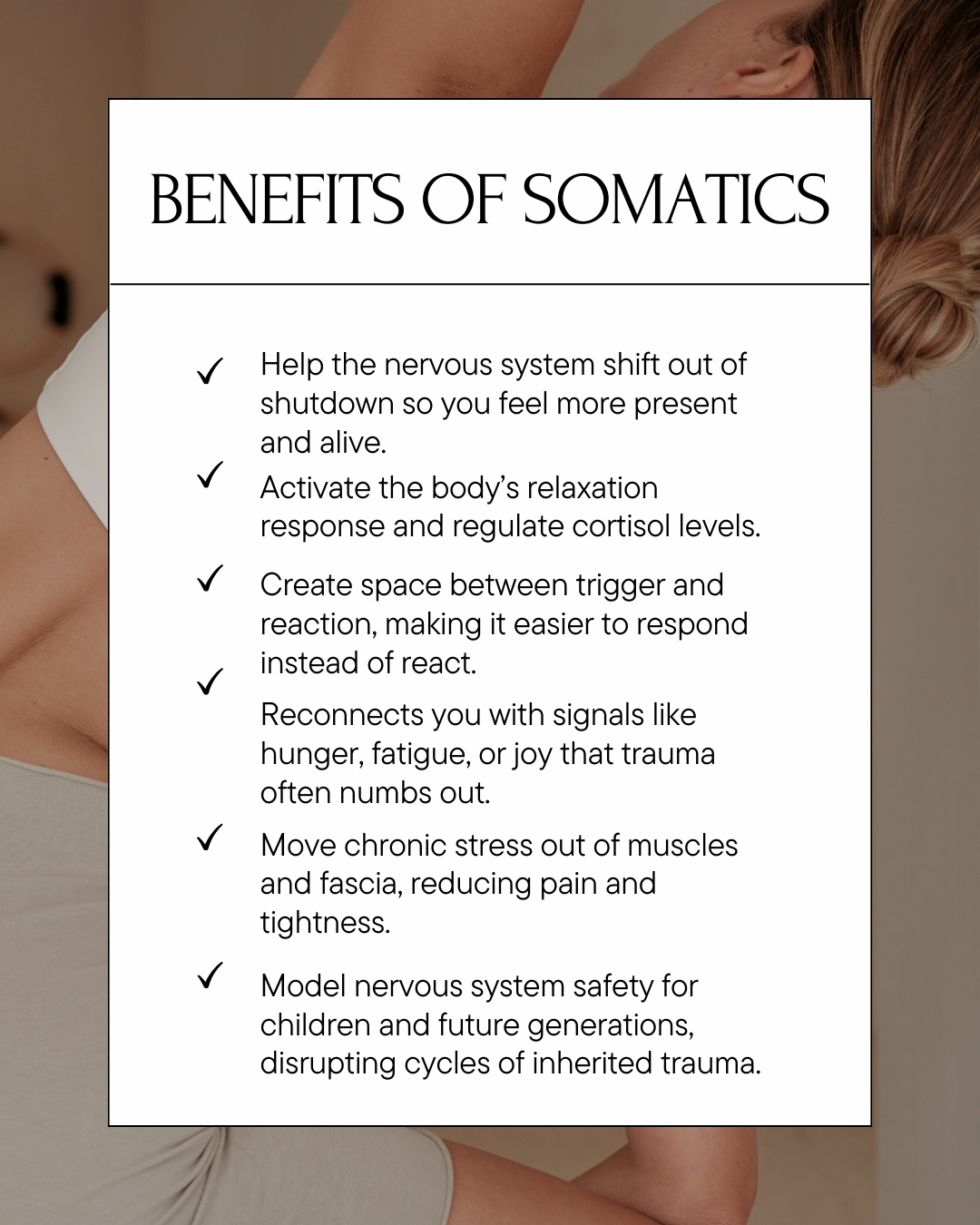
Why Somatic Work Matters for Generational Trauma
Generational trauma doesn’t just hand down stories—it hands down states. Families that survived war, addiction, or chaos taught bodies to stay braced, numb, or over-alert.
By practicing somatic tools, you’re teaching your body a new story: I can be safe. I can be here. I can rest.
That’s how cycles break—not only for you, but for those who come after you.
FAQs About Somatic Healing and Generational Trauma
What are somatic practices?
Somatic practices are body-based exercises (like orienting, humming, or grounding walks) that help regulate the nervous system and release stored trauma.
Why does trauma live in the body?
Trauma activates the stress response. Without resolution, the body stays braced, leading to patterns of freeze, tension, or hypervigilance—even long after the danger is gone.
Can somatic practices heal generational trauma?
Yes. While no single tool “erases” trauma, consistent somatic practices retrain the nervous system, breaking inherited cycles of stress and shutdown.
How long do somatic practices take to work?
Some practices (like orienting or humming) bring immediate relief. Long-term change comes with consistency—daily reps signal safety to the body over time.
Do I need a therapist for somatic work?
Some practices can be done on your own. For deeper trauma or strong reactions, a trauma-informed therapist (somatic, IFS, EMDR) can provide support and safety.
Ready to get started?
If you’r searching for burnout recovery therapy in Philadelphia, a trauma therapist in Pittsburgh, or virtual trauma therapy across North Carolina and South Carolina, you don’t have to keep surviving in exhaustion.

I offer focused therapy intensives for adults who are still functioning but feel worn down by constant pressure, anxiety, or patterns that no longer work. This work is designed for people who want depth, clarity, and relief without labels or long-term weekly therapy. If you’re in North Carolina, South Carolina, or Pennsylvania and curious whether an intensive format could be supportive, you’re welcome to learn more.
Join me on Instagram, Pinterest and TikTok for more educational tips, trauma recovery insights, and updates on therapy intensives in Pennsylvania, North Carolina, and South Carolina.
Disclaimer
The content shared here is for educational and informational purposes only. It is not a substitute for psychotherapy, medical care, or individualized mental health treatment. Reading this blog or engaging with my content does not establish a therapeutic relationship.
If you are experiencing significant distress or feel you need personalized support, I encourage you to seek care from a licensed mental health professional in your state. Therapy is deeply personal, and the right support should be tailored to your specific needs, pace, and circumstances.
For adults located in North Carolina, South Carolina, or Pennsylvania who are seeking focused, confidential support, I offer customized therapy intensives designed to address chronic stress, internal pressure, and patterns that no longer work. Information about these services can be found throughout this site.
About the Author
Mariah Zur, LPC is a licensed therapist who works with high-achieving adults navigating chronic stress, internal pressure, and the quiet unraveling that can happen beneath outward success. Her work is especially suited for individuals who are highly functional, deeply self-aware, and exhausted from holding everything together.
Mariah offers therapy intensives for adults seeking focused, contained support without labels, long-term weekly therapy, or unnecessary exposure. Her approach is grounded, relational, and nervous-system informed, helping clients slow the internal spiral, regain a sense of control, and move forward with clarity and steadiness.
She provides intensive therapy services online across North Carolina, South Carolina, and Pennsylvania, with in-person options available in Raleigh, NC.
Credentials
Mariah J. Zur, MS, LPC
Licensed Professional Counselor
Doctoral Student, Counselor Education and Supervision
